

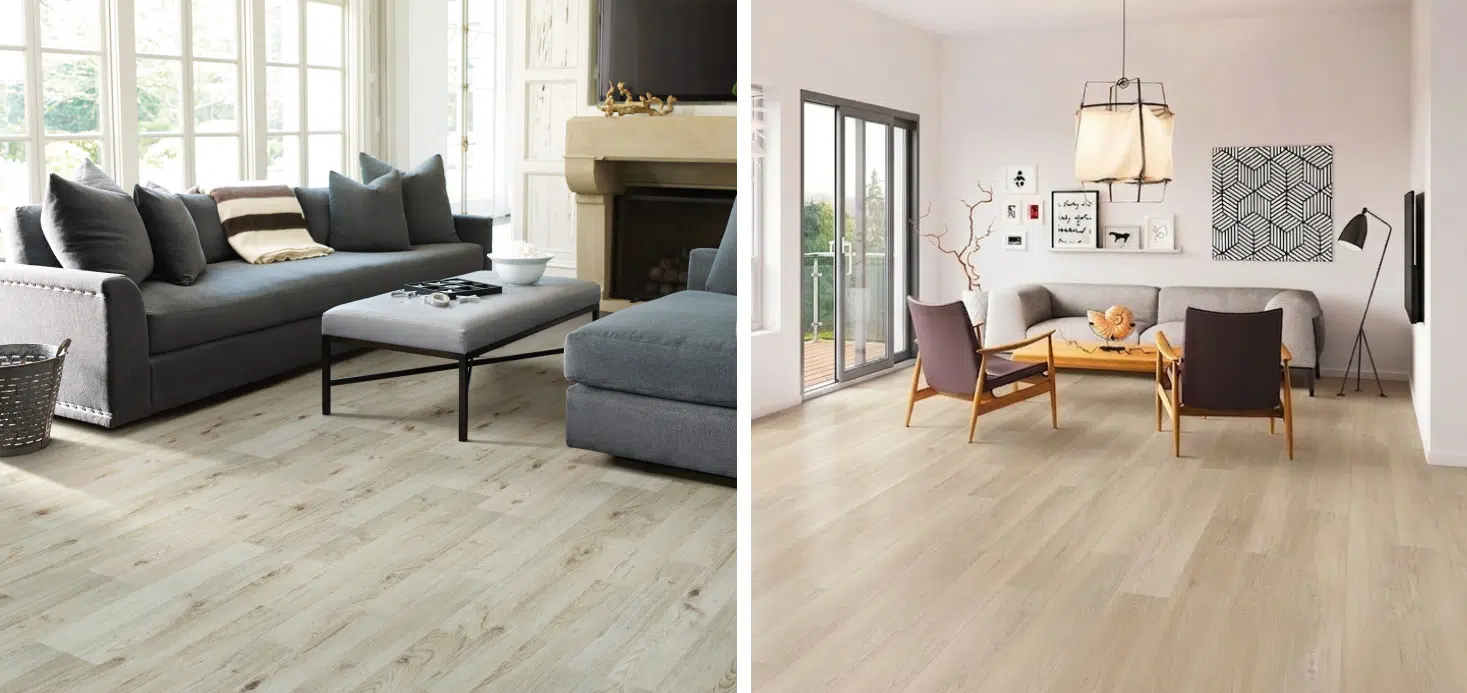
You use your floor more than anything in your home other than your bathroom. Your floor takes you from point A to point B to point C every day.
Because different floors tolerate different behaviors, the real question becomes: how are you going to live on it?
That’s what determines your floor’s performance.
In this article, you will learn how LVP (luxury vinyl plank) and laminate flooring are constructed, how they perform under real-life conditions, and how both compare to hardwood—the material they’re designed to imitate. By the end, you will know which floor is right for you and your life.
The History of Laminate & LVP
To understand why these products perform the way they do today, it helps to understand how the market evolved.
In the early days, you built the house and put down planks. You sanded, stained, and finished them — that was your floor for life.
Then wall-to-wall carpet came in, and people started covering their wood floors. Next, it was vinyl.
That’s why our industry is called floor covering. You already have a floor. Maybe it’s plywood, OSB, or concrete. But you can’t live on that, so you cover it.
The Early Vinyl Era
Old vinyl flooring consisted of the commercial 12’x12’ tiles you used to see in schools, gyms, and grocery stores.
Then you had sheet vinyl that came in big 12’ rolls. It was basically like rolling out a big sheet of plastic and gluing it down.
Next, the arrival of perimeter-glued (maybe three inches around the edges) versions made installs easier.
Then Mannington Gold changed the market.
Mannington Gold & The Warranty Strategy
In the 90’s, Mannington Gold offered thick, durable, perimeter-glued vinyl backed by a warranty that was unheard of.
The first year covered 100% labor and material replacement. No questions asked.
You could install it, decide you didn’t like it three months later, and they would replace it. Some people took advantage of it. But it worked.
For a while, it dominated the market.
But the same thickness that made it feel solid also led to shrinking and movement issues, so contractors started looking for alternatives.
That’s when laminate gained ground.
Laminate Flooring Arrives
Laminate came from the countertop world. Think Formica.
The idea behind laminate flooring was: how do we take that hard decorative surface and make it into flooring? Flooring manufacturers added a core, tested it, refined it, and put it on the market.
People bought laminate because it was durable. But it wasn’t waterproof. Failures followed, mostly related to water, job-site conditions, and the environment.
That’s when vinyl developed into what we now call LVP.
COREtec & Waterproof Clicklock LVP
COREtec’s arrival marked the moment when laminate began to phase away. When vinyl came back strong as waterproof LVP, demand for the product grew.
Flooring manufacturers released their best versions first. Later, they started introducing lower-quality versions to meet the demand.
That’s when WPC (Wood Plastic/Polymer Composite) and (Stone Plastic/Polymer Composite) vinyl cores entered the conversation.
WPC vs. SPC Cores
When you compare LVP products, you will notice that there’s two main vinyl flooring core types: WPC & SPC.
WPC has a thicker construction with more foam in the core. It feels like walking in your house slippers. WPC is warmer under foot and often sounds quieter.
SPC is rigid because of its calcium mineral content. It resists denting better than WPC but becomes brittle as it decreases in quality. It feels like walking in your winter boots.
With thinner planks, lower mills, and cheaper construction, SPC starts to get compromised. Drop something heavy on it, and it can break.
That’s the reason why WPC and thicker versions of SPC are returning.
Laminate Flooring Makes a Comeback
Laminate flooring never disappeared. It adjusted.
When laminate manufacturers noticed people having issues with lower-tier vinyl, they saw an opening. They enhanced the core to be denser and improved the edge protection and locking systems.
This improved version of laminate recaptured lost market share.
And just like vinyl before it, laminate had versions racing to the top in technology and versions racing to the bottom in quality.

Laminate Vs. LVP: The Key Differences Explained
When you talk about laminate vs. LVP, you have to include hardwood in the conversation because LVP and laminate are imitations of hardwood.
How Flooring is like Hamburgers
A hamburger is traditionally beef. That’s the original.
But now you have turkey burgers, veggie burgers, mushroom burgers.
Hardwood is the original.
Laminate and vinyl are alternatives built to solve specific problems related to cost, moisture, maintenance, and comfort.
Laminate and LVP are Hardwood Alternatives
Both LVP and laminate are synthetic with man-made patterns. They’re not like real hardwood where the character comes from the way the tree grew.
Because they’re artificial, these products can be engineered around certain problems, such as moisture, movement, cost, and maintenance.
Hardwood is the original, but it has limitations.
Hardwood is Limited by its Environment
Wood expands and contracts with moisture and heat. That’s not a flaw. It’s the natural behavior of living material.
You can do a lot to wood. You can sand it through different grits. You can stain it different colors. You can use oil-based finish, water-based finish, hard wax oil. You can hand-scrape it, wire-brush it, and distress it.
But there’s one thing you can’t do: you can’t make wood ignore its environment.
If the conditions aren’t right, the board is going to expand or shrink.
Which is Better, LVP or Laminate?
Neither category is automatically better. Construction determines what they’re good at and what they’re not.
With unfinished hardwood, you control the sanding, stain, and finish. With prefinished hardwood, the factory does everything for you. The trade-off is flexibility and customization vs. simplicity and durability.
Now apply that same thinking to laminate and LVP.


LVP Vs. Laminate: Surface Durability Vs. Core Stability
Surface versus core — that’s the real trade.
At the highest tiers, laminate wins at the surface. LVP wins at the core.
If you have a large dog with big nails, LVP is more likely to show the scratches because laminate’s surface is harder.
Laminate Offers a Stronger Surface
Laminate has a tough finish that’s scratch resistant. Luxury Vinyl Plank’s wear layer is plastic — six mil or twenty mil, it has give. From a surface standpoint, laminate often wins.
LVP Offers Better Moisture Resistance
The LVP core, especially SPC, will outperform laminate when it comes to moisture exposure every time.


Which Fails More from Faulty Installation?
From an installation standpoint, the stress shows up more in LVP systems because of how they behave over imperfect subfloors.
LVP’s locking mechanism is prone to failure when installed over an uneven subfloor. The locking mechanism is thin. Its job is to connect boards, not carry structural stress.
When you add stress beyond what it can handle, especially from an uneven subfloor, that’s when you have problems.
Many people wrongly assume that a floating floor will contour to the subfloor.
The issue is that it follows the subfloor.
If the existing floor has rolls or valleys, the planks will ride those highs and lows. When you walk across them, the joints flex.
Over time, that repeated deflection compromises the lock. You start seeing separation, broken clicks, movement. You start hearing a hollow sound.
The floor didn’t wear out. The system was stressed.
Overall, Which Floor is More Durable Long Term?
In 40 years of doing this, I’ve never seen an indestructible floor.
Every material has a limit to exposure. Ask three things:
- What kind of damage?
- Under what conditions?
- How often will those conditions occur?
Longevity Depends on Exposure and Product Level
Both laminate and LVP are durable. In many cases, they’re more durable than wood under normal foot traffic. But durability always depends on use.
In a low-traffic, controlled home, most floors perform well.
It’s when you introduce toddlers dragging toys, multiple pets, large dogs with heavy nails, construction boots carrying grit, spike heels.
Each element changes the equation.
Sheen & Wear Layer/AC Rating
Sheen matters. Higher gloss shows more scratches. A lower sheen hides them better.
Wear layer thickness matters. A 12 mil will generally show wear sooner than a 20 or 28 mil. The same logic applies to a lower laminate AC Rating versus a higher one.
Laminate, especially with a lower sheen, tends to hide surface scratching the best. It doesn’t mean it won’t scratch — it will — but it’s often less visible.
Vinyl resists scratching, but the layer has more give, so you may see wear more than you would with laminate.
Aesthetics & Realism
Early laminate and vinyl looked artificial. Pattern repeats were obvious. The texture didn’t match the image. It was clearly a printed floor.
Today, both products have come a long way in realism.
Realism from Embossed in Register Technology
What separates entry-level from premium products is texture.
Higher-end product lines use embossed-in-register technology, where the texture follows the grain pattern in the image. When you see a knot, you can feel it. When you see wire-brushing, you can feel the ridges.
That alignment creates depth and reduces the flat look older products had.
Higher-end laminates, such as Mohawk’s Revwood, synchronize texture with the image.
For the most realistic non-wood option, vinyl often has a broader selection and deeper textures, especially in higher tiers.
Color is Usually the Deciding Factor
Here’s the part people don’t always admit.
Color usually wins.
Regardless of durability, longevity, specs, or construction, most people buy the floor they fall in love with. If the color is perfect, most people overlook the technical boxes.
It’s like buying a car. You don’t go to the dealership with a torque wrench and test the components. You sit in the seat. You like the way it feels. You like how it looks.
Flooring is the same.
Sound Deadening Depends More on the Flooring System
Which sounds more hollow over time, laminate or LVP?
First, understand this: most laminate and most clicklock LVP are floating floors.
That means they’re not fastened to the subfloor. They sit on top of it and move as one connected surface.
Because of that, hollow sound isn’t strictly a laminate vs. vinyl issue. It’s a floating system issue.
Sound depends on:
- Overall thickness
- Core construction (HDF vs. SPC vs. WPC)
- Attached pad or separate underlayment
- Subfloor flatness and prep
Laminate often feels and sounds more solid because of its dense wood-fiber core. SPC vinyl can sound harder or sharper. WPC vinyl is usually quieter because of its foam content.
Products with an attached pad typically sound less hollow than those without.
But if the subfloor isn’t flat, any floating system can develop hollow spots over time. And when you hear that sound, it’s usually movement underneath, not the surface wearing out.

The 100% Waterproof Truth
There’s really no such thing as 100% waterproof, and there’s too much focus on “waterproof.”
Most floors can handle what I’d call normal life water. You take something out of the refrigerator, spill a little milk, wipe it up, no issue. You’re cooking, you drip water between the sink and the stove. That’s not going to destroy the floor.
The real problem isn’t drips.
It’s chronic leaks, plumbing failures, your sump pump backing up. It’s a floor sitting in water.
Here’s the reality: a flood is a Mayday event.
And it’s usually a homeowner insurance situation.
When water mitigation crews arrive, their job is to stop damage fast. They’re not carefully labeling planks so you can reinstall them later. They’re pulling material up, so water doesn’t keep feeding mold underneath.
In theory, you could remove vinyl carefully, lay it out crisscross, flip it, let it dry — especially if it has cork backing — and reuse it.
In practice, that rarely happens in a true emergency.
Is Laminate Waterproof?
Laminate’s water resistance applies to surface exposure; if moisture reaches the wood-fiber core, damage can follow.
People often describe laminate as having a “cardboard core.” That’s a layman’s term. It’s not literally the material of a cardboard shipping box.
Technically, the core is HDF (high density fiberboard) or MDF (medium-density fiberboard).
Both are dense, engineered wood fiber pressed together.
And wood fiber reacts to water.
If laminate sits submerged, it’s typically not reusable. Once that core swells, it’s done. It’s waterproof from above, under controlled conditions.
Everything has to be tight. Locks fully engaged. Perimeters sometimes sealed with silicone. Because once water gets past the surface and into the core, swelling starts.
Is LVP Waterproof?
On the vinyl side, some manufacturers will tell you it’s 100% waterproof. You can dip it in water, pull it up, dry it out, and reinstall it.
Vinyl cores are synthetic, so water won’t cause swelling.
Many vinyl products can technically be dried and reinstalled, depending on the manufacturer, the backing, and how the planks were removed.
Overall, vinyl handles water exposure the best.
But if you’re talking about standing water in your home, it won’t matter what kind of floor you have.
The Fish Tank Test
If you want to see for yourself how these products tolerate water, you can perform a simple test. You can take a piece of laminate, a piece of LVP, and a piece of hardwood and drop them into a bucket of water for a few days.
We use a fish tank.
Here’s what you will see:
- The hardwood reacts quickly.
- The laminate reacts next. It swells as the core absorbs water.
- The vinyl? Structurally, it doesn’t swell.
That doesn’t mean the system is invincible. But it shows you the difference in core behavior.
And that’s really what separates them when it comes to water.

Final Thoughts
At the end of the day, LVP, laminate, and hardwood are options that solve different problems.
Hardwood remains the benchmark. It’s a lifetime floor that offers authenticity and the ability to refinish, but it will always answer to its environment.
Laminate offers a harder surface that hides wear well, but its core has limits with moisture.
LVP handles water exposure best, but its surface is less scratch resistant than laminate’s.
No floor is indestructible. The right choice depends on how you live.
Do you remove your shoes?
Do you have large or active dogs?
Is moisture part of daily life?
Are you planning to stay ten years or thirty?
Start there.
Then look at construction.
If moisture is a concern, COREtec, Happy Feet, and Shaw waterproof LVP are proven options.
If you want a harder surface with refined locking systems, quality laminate lines like TORLYS and Mohawk are engineered for it.
And if your conditions are stable and you’re thinking long term, hardwood is a lifetime floor.
If you’d like help narrowing it down, we can walk you through flooring options clearly.


