


Sheoga doesn’t rush a floor. The lumber dries naturally for months before it ever sees a kiln, and the molders run at a deliberate pace.
People still mark boards by hand with crayons, right next to an X-ray scanner that looks inside the wood.
Homdi Soliman, (Panel Town’s Vice President), Ben Mangen, (one of our flooring specialists), six Columbus flooring contractors, and I toured Sheoga in Middlefield, Ohio, on October 21.
We visited the main plant, the finishing plant down the road, and one of the lumber mills.
Here’s what goes into one of their floors, and what it means for the floor you buy.

Sheoga grew out of a local lumber mill
Sheoga started in 1982, when a group of shareholders from a local lumber mill decided to open a hardwood flooring and paneling company. Forty-four years later, it’s still growing. When we visited, they’d just cleared ground for a new building.
When I ask contractors around Columbus about the best flooring, Sheoga is the name that comes up often.
The people behind Sheoga’s floors

Inside one of the lumber mills
Many of the people on Sheoga’s line have been there for decades, and some of their children now work there too.
Sheoga sits in the hills of Geauga County, home to the fourth-largest Amish settlement in the United States.
Most of the craftsmen on the line are Amish, from that community.
The plant floor looks like the community it sits in. Men with beards, suspenders, and wool pants run the machines, most of them handling rough planks without gloves. Women in long dresses and bonnets work the line too.
There’s a basketball hoop between stacks of unfinished hardwood, and on one break we saw a few of the crew shooting free throws. On my way out, I passed a couple of scooter bikes with straw hats hanging from the handlebars.
When I arrived at 8 a.m., I couldn’t find my group. A man on a forklift drove up to me and offered to help. He put the forklift in reverse and drove backwards to the main office while I followed.
The wood dries outside first, then in the kiln
Sheoga air-dries its lumber for six months before it goes into a kiln.

They buy it from Ohio, West Virginia, Indiana, Kentucky, and Pennsylvania, and grade every board on site when it comes in. When we walked the yard that morning, the stacks were sitting out as the sun came up, and off to the side, the kilns were already running.
Throughout the year, a wind comes up from the valley below and helps dry them.
According to the NWFA, air drying generally brings lumber down to 18 to 30% moisture content, and kilns typically take it the rest of the way.
Months in the yard means the kiln starts with less water to pull. Sheoga takes its flooring down to 6 to 8%.
Once the floor is in your house, keeping it steady is your part. Sheoga says its floors do best at 35 to 50% humidity and 60 to 80°F, and a hygrometer tells you where your house actually sits.
After the kiln, Sheoga conditions the wood. At the start of the tour, we saw how a stress test makes those hidden forces visible.
Cuts in a wood sample leave narrow prongs that can bend inward as the stress is released. It shows why getting the moisture content right is only part of preparing a board for milling.
How a hardwood flooring stress test works
The diagram and picture below illustrate how the test works.
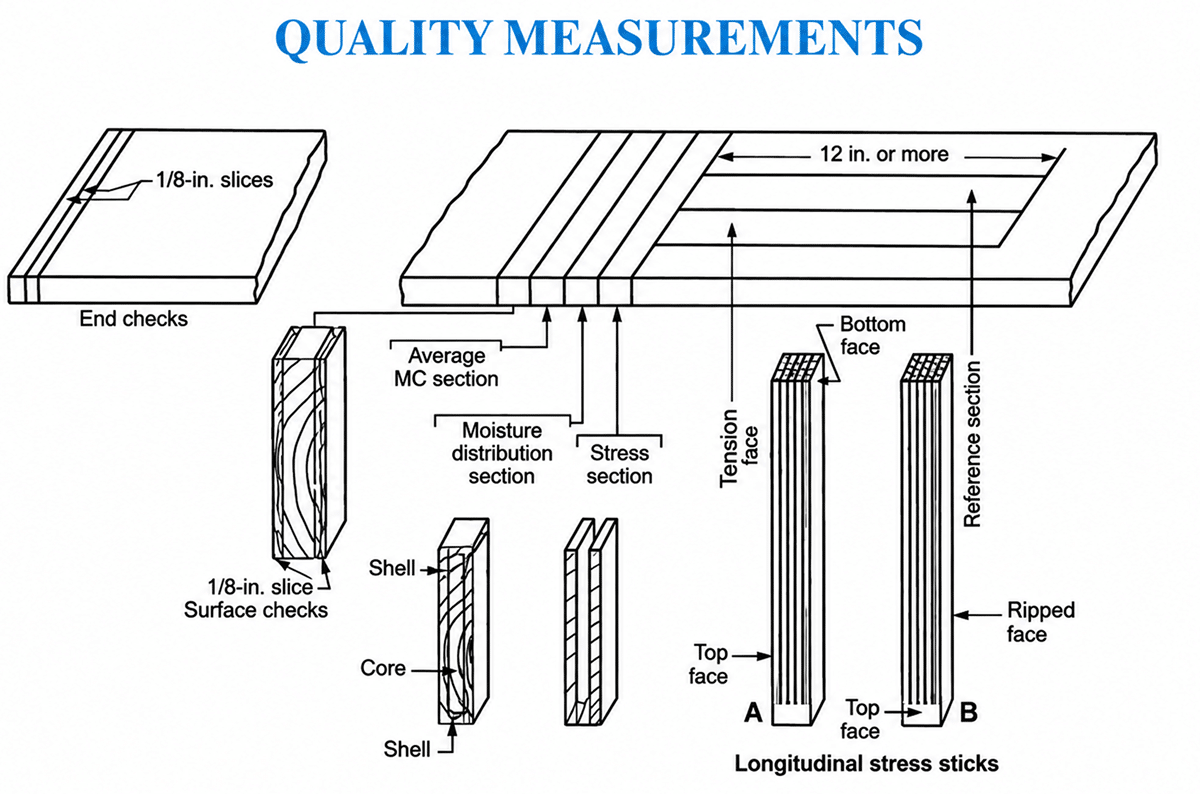
Diagram courtesy of Robert McNamara, Sheoga Flooring.

Slow milling makes the boards fit tight
Sheoga feeds its molders by hand and runs them slowly with diamond tooling. That cuts a tighter tongue and groove along the long edges and a tighter end-match where boards meet end to end.
A consistent fit reduces overwood, the board-height differences that come from manufacturing. Get it right and you get what Robert McNamara, Vice President of Marketing and Sales, calls “a nice, flat, relaxed floor.” Larry Yoder, Sheoga’s COO, who used to run its kilns, has said he hopes homeowners notice “the flatness with no squeaks.”
Milling is only half of it. Even the best-milled floor needs proper installation and stable indoor conditions.
To test the fit, lay out a few Sheoga samples, engineered and solid, and bring them together. You will see that they lock together with ease.
The contractors on our tour were impressed by how naturally they fit. Try it yourself. Push the samples together side to side and then end to end, and look for a tight seam with no lip. Then run the same test with a few other brands.
That precise fit is part of what you pay for with Sheoga. If you’ve ever stood over a floor yelling at boards that won’t go together, you know the other side of it.
Machines and people check the boards side by side
After the rough-sawn boards pass through the planer, a scanner looks at each one from every side.
The scanner uses cameras and lasers to find knots, cracks, decay, and stain, and X-rays to see inside the wood. On the tour, we watched it find problems hidden inside a board. The bad section gets cut out before the board moves on.
The plant also pulls samples to test the wood as it moves through, and lasers now guide bundling that used to be done by hand.

The old way never left, though.
Craftsmen still mark boards with crayons, the way they did before the scanner, and someone touches and inspects every board.
Above it all, a man sits in a raised booth called “The Eagle’s Nest” that overlooks the plant floor, watching every operation at once.
Sheoga’s engineered floor is built thick
Sheoga’s engineered floor is 3/4″ thick, with a 5.25mm wear layer on an 11-ply Baltic birch core. The wear layer is the top veneer of real wood, the part you walk on and sand.
Sheoga saws it as one thick piece and calls it “equivalent to our solid wood floors.” That’s about how much wood there is to sand, not a claim that engineered and solid are the same floor. Our guide to choosing an engineered wear layer breaks down what each thickness gets you.
Sheoga holds Baltic birch up as the substrate to beat. Many makers walked away from it, worried they couldn’t keep getting it, but Sheoga still uses it.
The cross-grained core helps the floor resist dimensional changes as temperature and humidity fluctuate. It also provides a stable base for Sheoga’s thick hardwood wear layer.
Sheoga’s engineered is rated for above-grade, on-grade, and below-grade installs done to Sheoga’s guidelines, but it isn’t made to float. Our engineered vs solid hardwood guide walks through where each one fits in a house.
The finish is cured before it leaves the plant
At the finishing plant down the road, Sheoga’s prefinished floors get a UV-cured ceramic finish, put on in layers and hardened under ultraviolet light. Each step gets a partial cure, and by the end, the finish is fully cured. With a prefinished floor, nobody has to apply and cure a finish inside your house.
Because the line runs in steps, a problem can be stopped and fixed at the step where it starts. We saw it happen. Planks started coming off the line half finished, and two Amish women stopped it to find the cause. They had it fixed within a few minutes.
If you’re still deciding, our guide to prefinished vs site-finished hardwood floors lays out both.
Custom trim, textures, and colors
Sheoga will match the trim, the texture, and even the color to your floor. It makes wood vents to match in standard or custom sizes. One of the craftsmen finishes the stair nose, and it can be ready in about a week. T-molding can be made to match too.
In the hand-scraped department, boards get clamped down and scraped one at a time, with the edges pillowed by hand. Country Worn comes off a machine Sheoga built, with several knives that make a pattern that doesn’t repeat. Age-Brushed, their wire-brushed texture, is on the heavy side.
Herringbone and chevron are made to order in custom widths, in a department of their own with a dedicated machine. These patterns generally add 1 to 2 weeks to the lead time, depending on the time of year and the pattern.
Sheoga also makes custom stain colors to order. But matching a color means stopping the entire finishing line, so expect a fee and a minimum order.
Sheoga recommends buying everything for the job at one time: the floor, the vents, the stair nose, the trim, and a few spare boxes. Each batch’s sheen is held within about 5% of a control sample, so a reorder a year later may not match exactly. Color and grain can vary between batches too.
Interested in Sheoga hardwood flooring?
After the tour, it’s easy to see why many of the contractors we work with prefer Sheoga.
In 35 years of selling Sheoga hardwood flooring, Homdi recalls fewer than five product claims.
Sheoga’s long boards are difficult to ship.
If you’re considering Sheoga for your home or your next project, contact us or stop by the store. We’ll show you the floors and help you find the right one.


