

If you’re shopping for luxury vinyl plank (LVP), you have probably been doing it by color, price, and whether the box says “waterproof.”
Installers shop differently. They check the locking system and profile, wear layer, core construction, subfloor tolerance, and whether a product has a track record that doesn’t generate callbacks.
That difference is why some LVP floors last for years and others start gapping within months. In this guide, we use the same framework to find the best LVP flooring in 2026, ranked by what determines whether a floor holds up. Not by marketing claims.
Quick Picks: Best LVP Flooring by Situation
How We Chose the Best LVP Flooring
Not every spec on the sheet matters equally. Here’s what we weigh and why.
Wear Layer
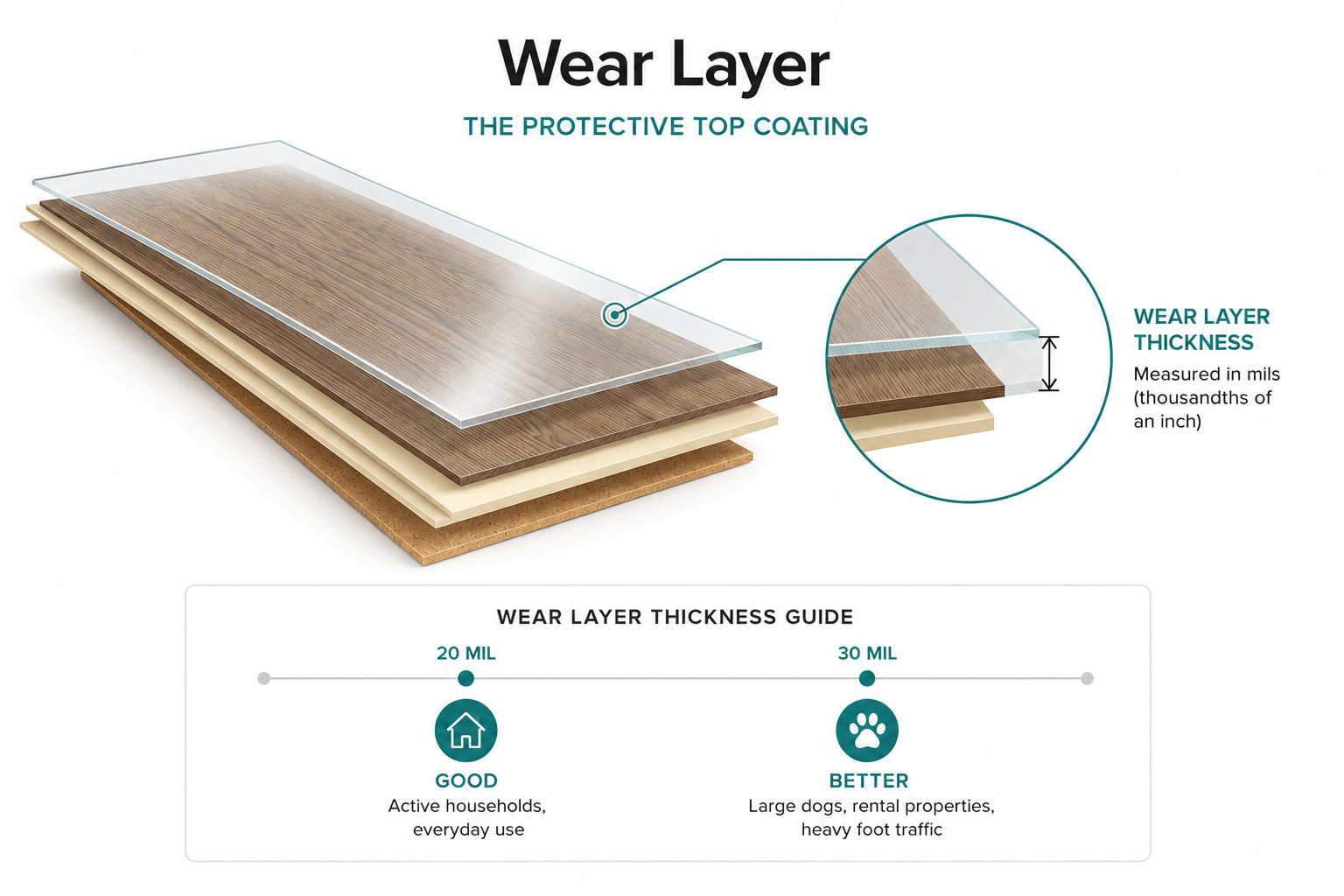
Measured in mils (thousandths of an inch, not millimeters), the wear layer is the protective coating over the printed design. It’s what absorbs daily use. For an active household, 20 mil is the practical minimum.
Do you have large dogs, rental properties, or expect heavy foot traffic? 30 mil is worth it. See our vinyl flooring thickness guide for a full breakdown.
Locking System
This is the one you’re most likely to skip. The locking system determines how planks connect and, more importantly, how they stay connected. We cover this in its own section below.
Core type
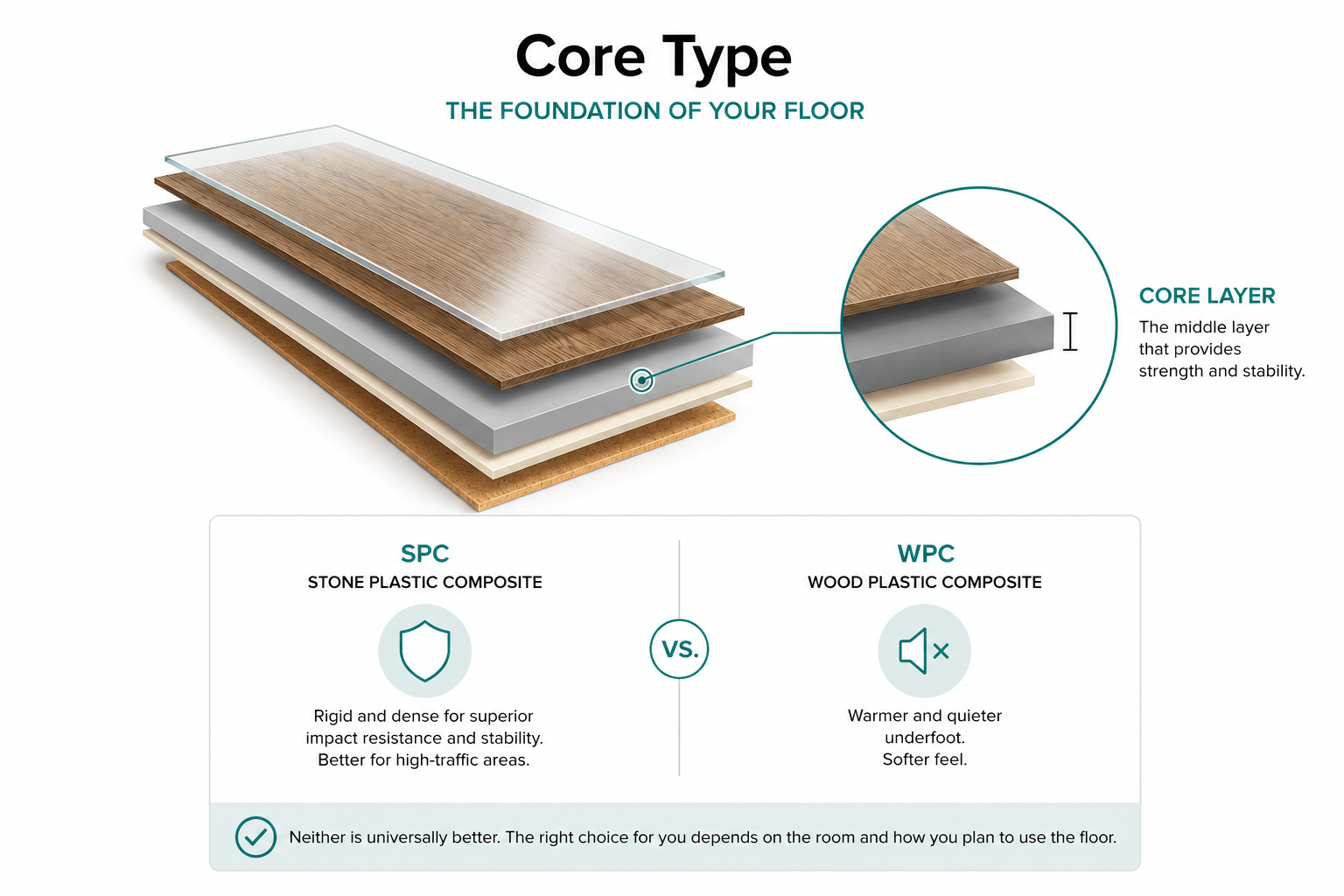
SPC (stone plastic composite) is rigid and dense, so it’s better for resisting impact, which means less chance of seeing dents in your floor. Additionally, SPC has greater stability than WPC when temperatures fluctuate. WPC (wood plastic composite) is warmer and quieter underfoot.
Neither is universally better. The right choice for you depends on the room and how you plan to use the floor.
Pattern variation
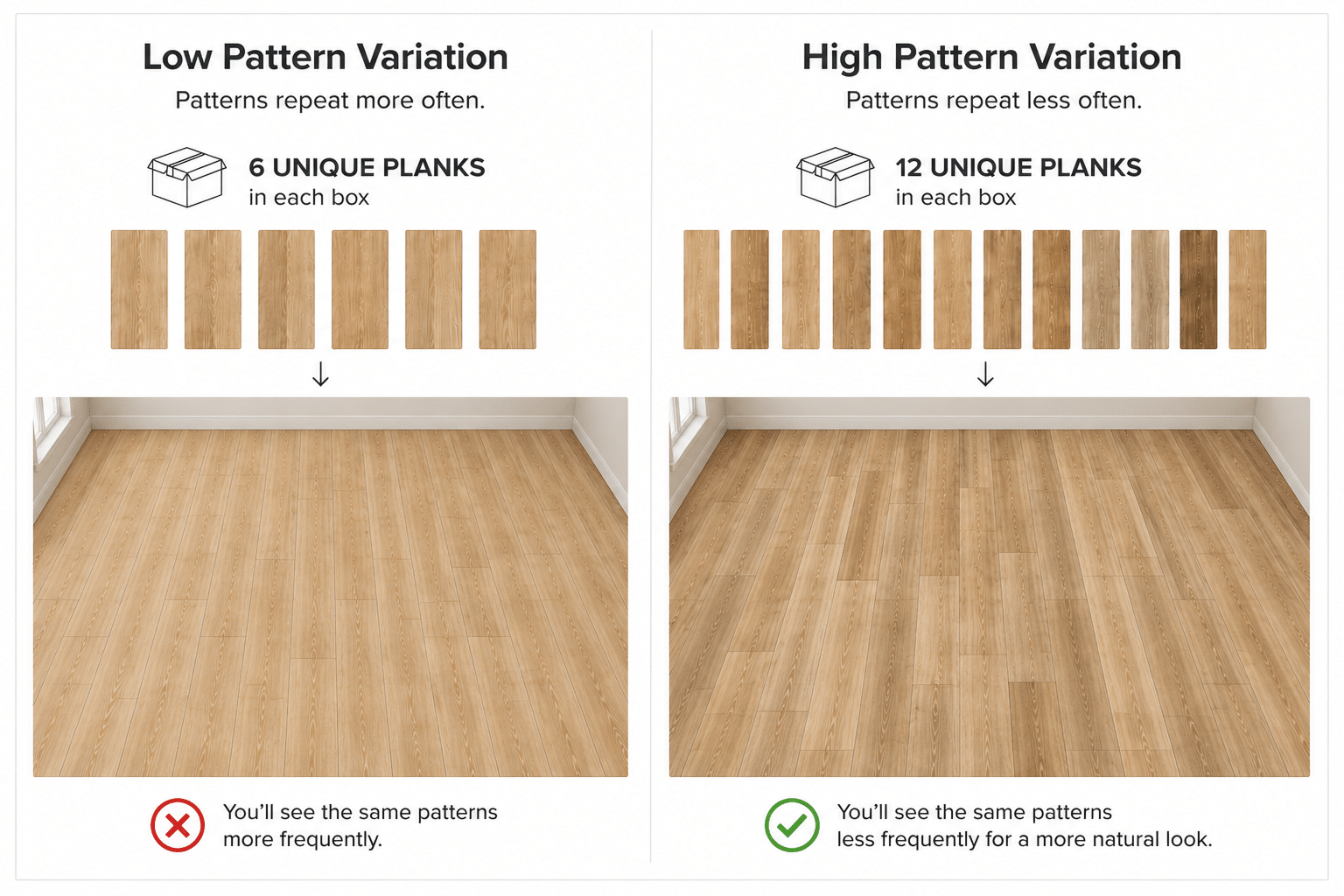
Cheap floors repeat the same pattern for a chintzy look. In open spaces, a low pattern count makes a floor look fake. More unique plank patterns per box means a more natural looking floor.
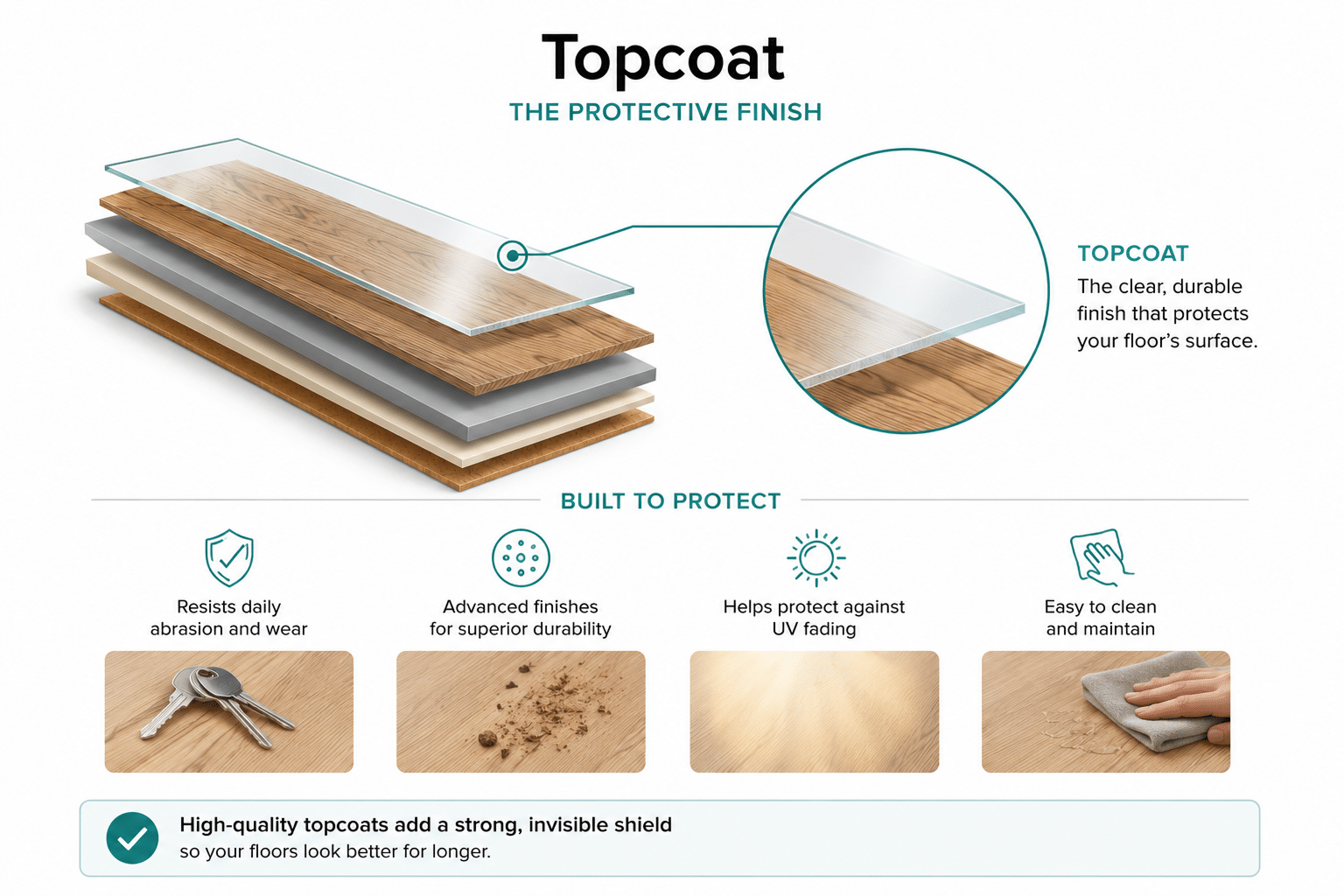
Topcoat
Aluminum oxide, ceramic bead, and enhanced urethane finishes generally resist abrasion better than entry-level UV acrylic coatings. The finish protects the wear layer surface from daily abrasion, and it’s worth checking what you’re getting.
Warranty fine print
Lifetime residential sounds the same on every box, but it isn’t. Most warranties exclude pet scratches, rolling loads, moisture that enters at the edges, and sun fading. The exclusions tell you more than the headline.
You can find the warranties on our product pages.
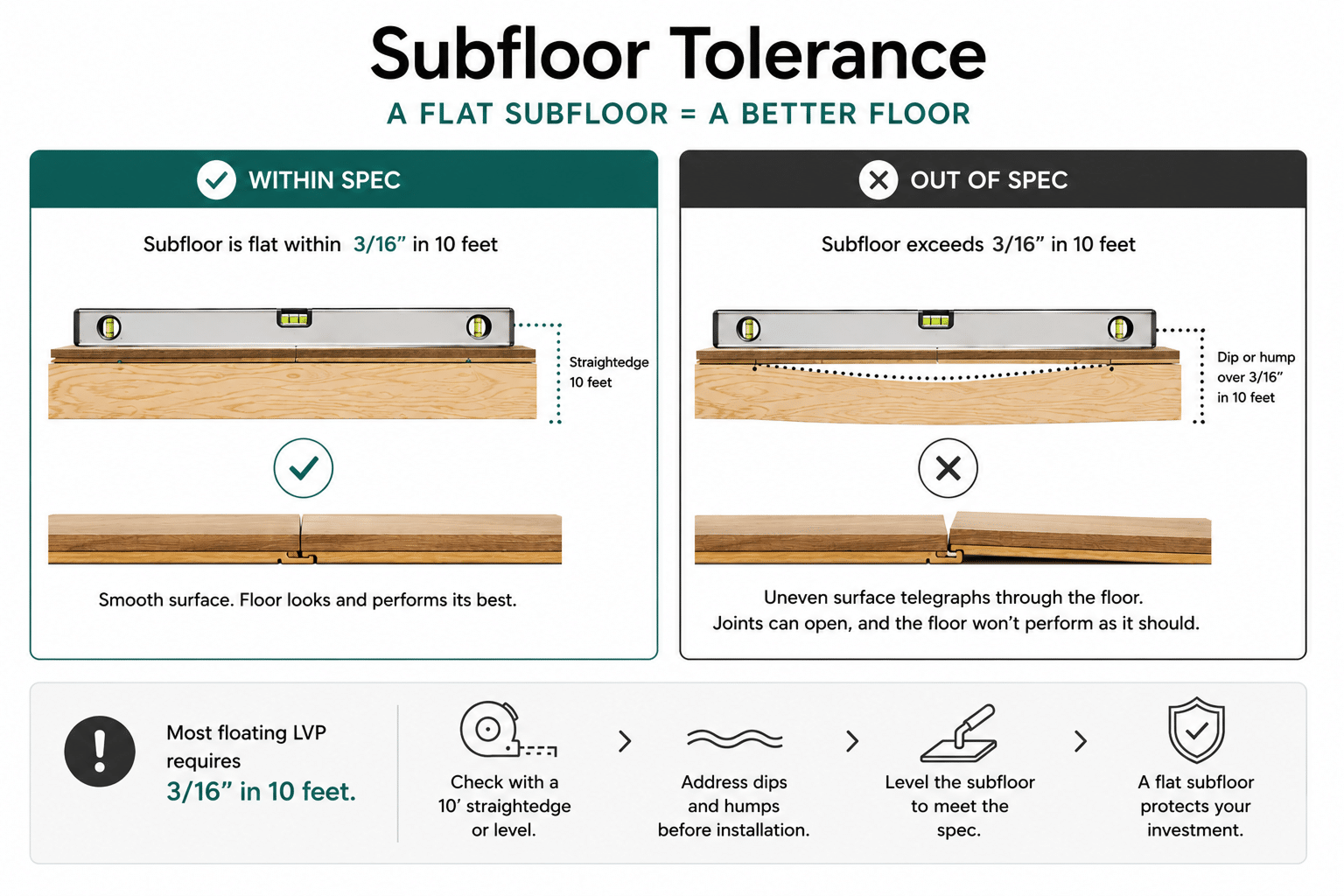
Subfloor tolerance
Every product specifies how flat your subfloor must be. Most floating LVP requires 3/16” in 10 feet. If your subfloor doesn’t meet the spec, installing the best floor on the market doesn’t matter. It will telegraph every dip and high spot through to the surface. See our guide to leveling a floor to address this before installation.

Our Best LVP Flooring
These are the floors we offer at Panel Town. We know them well enough to answer real questions about them, handle issues after the sale, and recommend the right one for a specific install situation.
COREtec Originals Premium
COREtec Originals Premium is the best LVP for most homes. The combination of a 30 mil wear layer, waterproof WPC foamed core, and 3mm cork backing puts it in a different league when compared to standard LVP products.
The cork matters more than people expect. It makes the floor noticeably quieter than SPC products and warmer underfoot. At 15mm total thickness, this is a genuinely solid floor. The multi-length plank format adds the kind of visual variation that single-length floors can’t achieve.
COREtec uses Unilin’s Uniclic Angle/Tap, one of the best tested locking mechanisms in the industry. It installs above, on, and below grade with no acclimation period required.

Who it’s right for
If you want a premium, comfortable floor that will look and perform well for decades without second-guessing your choice, this is it.
Good to know
WPC doesn’t resist heavy point loads as well as SPC. In spaces with office chairs on wheels, heavy appliances on small feet, or significant rolling loads, SPC is the better core choice.
Best for Durability
Shaw Floorté Infinite SPC
For high-traffic entryways, kitchens, rental properties, and homes with multiple kids and pets, we recommend Shaw Floorté Infinite SPC.
The 20 mil wear layer uses Shaw’s ScufResist® finish, a UV-cured poly finish with aluminum oxide that holds up against the daily abrasion that wears through lesser finishes. SPC’s rigid core resists denting better than WPC and doesn’t expand and contract as much with temperature changes.
That stability matters in rooms with direct sunlight, large temperature swings, or moisture-prone spaces like basements.

At 4.4mm, Infinite SPC isn’t a thick floor. But thickness alone doesn’t determine durability. Shaw built this line around a rigid SPC core and a highly abrasion-resistant finish designed for high-traffic environments.
Starting at $3.99 / sq ft, it’s a tough floor from a major manufacturer with real warranty support at a competitive price. You can install it above, on, or below grade as a float or glue-down.
Best Value
Happy Feet Dynamite Plus
For a 20 mil SPC floor with a 25-year residential warranty, a tough finish, and an attached pad at $4.16 / sq ft, Happy Feet Dynamite Plus is our top value pick.
The Stabilicor® Plus core is enhanced stone polymer composite. The attached pad saves a step on installation and adds noticeable comfort underfoot. FloorScore® certification confirms the product meets indoor air quality standards. (For more about what that means and the broader vinyl safety questions, read our vinyl flooring controversy post.)
The angle/angle locking system is proven and durable. It’s slightly more work in tight spots —you need to lift the whole row to lock the short end—but it stays in place once set.

Who it’s right for
If you want the best performance relative to price, this is the one to get. Great for secondary rooms, rental properties, and large-area projects.
Good to know
Angle/angle can be frustrating in complex layouts or near fixed cabinets where lifting and angling isn’t easy. Read the warranty exclusions before assuming 25 years covers everything.
Also from Happy Feet: Dynamic Fit™ (28 mil, Loose lay)
Dynamic Fit™ gives you a 28 mil wear layer with a fiberglass-reinforced core, and you can install it as a loose lay or glue-down. This makes it well-suited for commercial spaces and renovations where you need a fast turnaround.
The surface finish combines urethane, ceramic nanoparticles, and a proprietary coating for increased protection against scuffs, stains, and wear. Wide 9” x 60” planks and a lifetime residential / 30-year commercial warranty back up its position as a premium product.
Loose lay installation works well in specific situations: concrete subfloors with minor irregularity, rooms where you want to avoid adhesive, or spaces where future removal matters. It’s a different job than the Dynamite Plus click floor. See our guide to glue-down vinyl plank flooring if you’re deciding between the two.


Other Brands Worth Knowing About
We don’t carry these products. But the LVP market is broad, and some of these products come up constantly in online research. Here’s a look at the ones we see most often.
Flooret Modin Signature (40 mil SPC, Direct to Consumer)
The 40 mil wear layer on Modin Signature is one of the strongest spec packages in its price tier for a direct-to-consumer product. The 9” x 72” plank size adds visual scale that many LVP products can’t match. SPC core and 27 color options make it a good package.
It may be worth ordering a sample to check and compare before buying. One thing to be aware of is their warranty. It states that store credit is the sole remedy and covers defective product only.
Mannington ADURA Max (WPC, 20 mil)
ADURA Max is Mannington’s WPC comfort option. The HydroLoc core, Microban antimicrobial treatment, and ScratchResist package are legitimately useful features, not marketing filler. At 8mm total thickness with an attached pad, it’s a comfortable, quiet floor with a 71-color selection.
Hewn Stoneform Elite (30 mil ceramic wear, stone composite)
Stoneform Elite uses a stone composite core rather than standard SPC or WPC. The 30 mil ceramic-enhanced wear layer and 9” x 72” long-plank format give it a design edge that standard LVP doesn’t match. Unilin locking, 20-year residential warranty.
It’s worth a look if you prioritize realistic vinyl aesthetics and are willing to pay for it. The Versaform loose-lay option in the Hewn line is also worth knowing about for concrete and basement installations.
Karndean Art Select
Known for its wood and stone visuals and low pattern repetition, Karndean Art Select gives you realism and layout versatility. Much of the collection is glue-down, which helps you achieve herringbone, parquet, and mixed format layouts.
Unlike SPC-heavy collections that compete mainly on specs, Art Select focuses heavily on realism, texture, and layout flexibility.
LifeProof (Home Depot)
LifeProof is a brand umbrella with different tiers of quality. The 6 mil entry-level products are a poor choice for active homes. The 12-mil line is okay for light use, but nothing more. The 22 mil and 30 mil LifeProof lines, however, offer a better balance of price and performance.
Are you thinking about installing a LifeProof floor and comparing it to products in our inventory?
If so, make sure to look at everything. Not just the wear layer. Check the core type. Look into the locking system. Understand the warranty exclusions.
When you compare these details side by side, the differences become easier to see.
Most Popular LVP Styles in 2026
The big style shift in LVP is away from gray floors and toward lighter colors with natural wood visuals. Most people are going with beige, brown, greige, and honey blonde LVP for a brighter aesthetic.
This shift isn’t just promotional. The data comes from Roomvo, a flooring visualization platform. Thousands of retailers, manufacturers, and distributors use this platform. The data comes from an analysis of 240 million customer interactions across 180 countries.
If you want a color that’s appreciated worldwide, choose a shade of Beige or brown. Get it in wide plank with a matte finish.
For bathrooms, kitchens, and entryways, stone-look LVT is also on the up and up. As print technology continues to improve, printed images become more crisp and varied, so the floor’s surface more closely resembles real material.


Locking Systems
If you’re standing in front of two floors with similar price points, the locking system is the main factor that determines which one is still performing in five years.
Here’s the three common systems and how they work:

1. Angle/angle
The long edge locks in at an angle. Then you lift the plank slightly and the short edge locks in at an angle too. This means you have to lift the entire row to connect each new plank on the short side.
Angle/angle is a proven, well-tested profile with a long track record. But it’s more difficult to install in tight spaces and more cumbersome in complex layouts.
2. Angle/tap
The long edge angles in the same way as angle/angle. You then use a tapping block to tap flat the short end. Angle/tap is currently the most prevalent locking system because it gives you a strong mechanical lock with greater flexibility. Compared to angle/angle, angle/tap is easier to install near door jamb, fixed cabinets, and other obstacles.
3. Drop-lock (5G, fold-down)
You drop the plank straight down vertically and lock it into place. Drop lock is the fastest way to install LVP, especially for DIYers. Modern versions from Valinge, Unilin, and i4F have improved considerably compared to how they were initially.
Drop-lock systems rely more on subfloor flatness than angle-based systems. Hollow spots can have more of an effect on drop-lock systems. But for any type of vinyl flooring install, you want your subfloor level.
For more on what separates quality rigid core LVP from entry-level, see our four pro tips for buying rigid vinyl flooring.
Locking profiles
The locking profile makes or breaks the locking system. What is it exactly? It’s the shape of the plank’s edge design, the male/female connectors that keep planks together.
Not all locking profiles perform equally well.
Unilin tested their Uniclic profile head-to-head against competing profiles on identical SPC cores. They found theirs had 86% more tensile strength, twice the number of castor chair cycles before failure, and 60% stronger short-side locking.
Granted it’s their own test, but it’s worth knowing because profile strength factors into how well a floor stays in place and for how long. You may have to dig to find locking profile data, which isn’t on most spec sheets.
The best LVP has a high-end locking profile. No surprise that bottom-tier products with second-rate locking profiles fail more often.
SPC vs WPC:
Which Core Should You Choose?
Core choice depends on the room and how you’re going to use it. Core affects feel, stability, and how the floor responds to load and temperature. Both core types can work in any room. For more information, read our guide on rigid core flooring.
SPC
SPC is a denser more rigid floor that holds up better under heavy loads, furniture legs, appliances, and rolling loads. An SPC core won’t expand or contract as much in spaces where the temperature and humidity can fluctuate. Overall, it’s a great choice for high-traffic areas, basements, and sunrooms.
WPC
WPC is a waterproof foamed core. It’s warmer and better at absorbing sound. The comfort difference is real and noticeable. WPC is typically thicker and better able to bridge minor subfloor imperfections. It’s better than SPC in bedrooms, living rooms, and open-plan spaces where you want a more cushioned surface.
The Waterproof Facts
The floor may be 100% waterproof, but the floor system isn’t. Water can pass through seams, edges, and perimeter gaps if there’s an appliance leak or massive spill. Moisture that reaches the subfloor beneath a floating installation can sit there for a long time. And that’s when real problems can develop.
The plank is 100% waterproof, but odor, mold, and subfloor damage can still occur without ever damaging the plank itself.
You must still manage moisture at the edges and beneath the floor, which determines whether the plank stays dry.

Pro Checklist:
8 Questions to Qualify a Vinyl Product
Run through this list to find a quality LVP floor.
Is the wear layer at least 20 mil?
Is the locking system angle/tap or a proven drop-lock from a named manufacturer (Unilin, Valinge, i4F)?
Can you flex the locking lip easily by hand, or does it feel solid? (sample required)
What’s the subfloor flatness requirement, and does your subfloor meet it?
Is the floor rated for installation above, on, and below grade?
Does the warranty require a vapor barrier and allow you to install over concrete?
What does the warranty exclude?
How many unique plank patterns are in the box?
FAQ
What’s the safest LVP style to choose?
Natural oak look with moderate grain variation and a matte finish works across most design styles.
Is wide plank LVP still popular in 2026?
Yes. Wide plank LVP makes the room appear larger and gives you a more premium look. Higher end collections tend to feature 7” – 9” planks.
Is a 20 mil wear layer enough?
20 mils suffices for most high-traffic residential spaces and even some light commercial. For commercial-grade protection, we recommend 30 mils.
Is SPC or WPC better?
What LVP is best for dogs?
Is LifeProof LVP good?
Can LVP go in basements?
Can LVP go over tile?
What LVP should I avoid?
Conclusion
What separates a good LVP floor from a bad one is the construction beneath the surface: the locking system, the core, the wear layer, and whether the product can hold up.
The best luxury vinyl plank flooring in 2026 comes down to choosing the floor for the way you live. A rigid SPC floor makes sense in high-traffic homes, rentals, and basements where stability matters most. A thicker WPC floor brings more comfort, warmth, and sound reduction in bedrooms and living spaces.
And regardless of core type, the details that matter most are the ones people often overlook: locking profile quality, subfloor prep, finish durability, and warranty exclusions.
A quality LVP floor should feel solid underfoot, stay locked together over time, and last until you want to make a change.
That’s why installers pay attention to the mechanics of the floor instead of just the showroom sample. When you compare products this way, the differences between entry-level vinyl and premium LVP become much easier to see.


